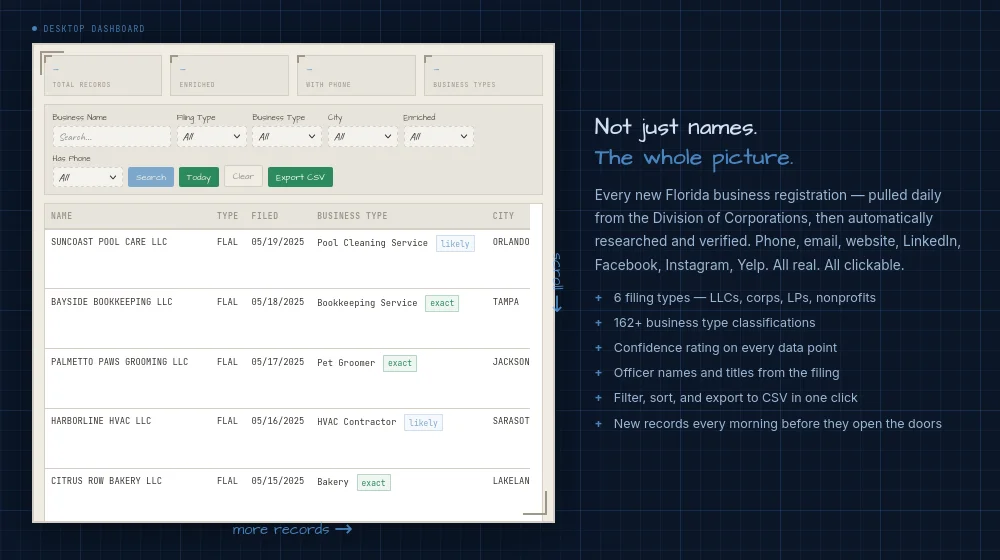
Around 2,000 new businesses register in Florida every day. The public record for each one is thin: a name, an officer, an address. No phone number, no website, and no idea what the business actually does. For anyone who sells to new businesses, that data is valuable but unusable as it stands.
FirstFile was our answer: a fully automated pipeline that turned those raw filings into verified, categorized records and delivered them every morning. In its first month it enriched more than 30,000 businesses, and over its run it processed more than 70,000.
Step 1: Ingest everything, every day
Each morning the pipeline collected the previous day's filings across six filing types (LLCs, corporations, partnerships, nonprofits, and more) and parsed them into clean records. No manual downloads, no spreadsheets.
Step 2: Let AI decide what the business actually is
A company name like "Blue Heron Ventures LLC" tells you nothing. So the first AI step categorized every business against the national NAICS industry list, the same standard the government uses.
Left alone, AI is great at classifying but inconsistent at labeling: our first pass produced nearly 7,000 slightly different industry names. A second AI step mapped those free-form labels onto 162+ clean, standard business types, so filters actually work. Records the AI was unsure about were flagged for a human to review instead of guessed.
Step 3: Search online, and let AI read the results
Next, each business was searched online. AI read the results and pulled out the website, phone, email, and social profiles, then every field was verified: matched pages re-checked and email domains validated. Each data point carried a confidence rating (exact, likely, or possible) with a short note on where it came from.
The AI cost for all of this came to less than a cent per record.
The day it quietly broke
Automation's biggest risk is not loud failures. It is silent ones. After one update, the workers kept reporting success, but the number of enriched records stopped climbing. One stage had quietly stopped processing.
We traced it, fixed it, and reprocessed the 37,000 records that had queued up behind it, enriching 15,000+ new records overnight. Then we added guardrails so it could not happen the same way again: limits on overlapping runs and checks that compare what the pipeline says it did against what actually landed.
Wrapping it up cleanly
In July 2026 we shelved FirstFile to focus on client work. "Shelved" meant every scheduled job shut down cleanly, with nothing left running and nothing left billing, and the whole system documented.
What this means for your business
The same pattern works on almost any data you already have:
- Categorize at scale: support tickets, leads, products, or documents, sorted by AI against the categories you care about.
- Enrich and clean up: fill in missing CRM details, standardize messy labels, and flag duplicates.
- Trust the output: confidence ratings and human review where it matters, so AI never guesses silently.
- Run it unattended: scheduled, monitored, and checked against reality.